
| August 3, 2026 | No.208 |
July 2026
(Back Issues Here)
We had 4.83 inches of rain at the Palmira Arriba Station during the month of July 2026.
Rainfall for July 2026 |
|||
Area |
Contributors |
July 2026 |
Total 2026 |
| El Salto Arriba | Beth Corwin | 3.73 | 18.89 |
| Los Cabazos | Don Hughes | 7.16 | 23.04 |
Jaramillo Arriba |
Steve Sarner |
n/a | n/a |
| Jaramillo Alto | Steve White | 6.07 | n/a |
| Jaramillo Central | Colleen Anderson | 4.66 | 22.83 |
Jaramillo Abajo |
John McGann |
4.84 | 36.59 |
| Palo Alto | Nancy Pettersen | 14.19 | 66.86 |
| Valle Escondido | Gisela Remsen | 5.38 | 24.24 |
| Brisas Boquetenas | Dennis Decorte | 8.35 | 57.90 |
| Brisas Boquetenas | Richard Sturtz | n/a | n/a |
Cerro Verde (Volcancito) |
Charlotte Lintz |
4.88 | 24.09 |
| Canyon Village | Denise McGhee | 3.31 | n/a |
| Caldera | Chris McCall | 4.56 | 32.41 |
| Lucero | Mike Joy | 5.57 | 27.56 |
| Palmira Abajo | Dave Nichols | 4.40 | 33.13 |
Palmira Arriba |
Lloyd Cripe |
4.83 | 27.75 |
| N/A = Not
Available Red = Highest rainfalls Green = Lowest rainfall |
|||
Checking the past data from the Palmira Arriba Station over a span of 20 years, the average rainfall for the months of July is 11.47 inches. The range is a low of 2.79 inches (2014) to a high of 31.02 inches (2008). This month's 4.83 inches at the Palmira Arriba Station is -0.99 standard deviations below the mean for the months of July. This is statistically lower than normal. It was a statistically drier than normal during the month of July.
Palmira Arriba Station Average July Rainfalls over 20 Years
.jpg)
At the Palmira Arriba Station we had 13 days with measureable light precipitation and 18 days without any precipitation.
The average winds in July 2026 at the Palmira Arriba station was 5.06 mph and generally from the NNE. Our maximum wind was 24.70 mph. Average temperature was 72.17 degrees F. The Highest temperature was 85.3 degrees F. The lowest temperature was 61.0 degrees F. You can check all the previous data for the months of May at this climate link.
In the Rainfall Table above note the variations in July rainfall in the different areas of the District of Boquete. A general inspection indicates generally low rain rates throughout the District. The highest rates were in Palo Alto (14.19 inches) reported by Nancy Pettersen and at Brisas Boquetenas (8.35 inches) reported by Dennis Decorte. The lowest rate was reported by Denise McGhee at Canyon Village (3.31).
You probably noticed that it was not only drier in July but temperatures and winds increased.
The table below is a comparison of July rainfalls and the Total Rainfall for the Year to the End of July over the course of 19 years of data collection:
| Year | July | Year to end of July |
| 2026 | 4.83 | 27.75 |
| 2025 | 6.84 | 68.42 |
| 2024 | 14.67 | 74.74 |
| 2023 | 10.26 | 48.04 |
| 2022 | 18.17 | 99.04 |
| 2021 | 10.77 | 48.77 |
| 2020 | 14.21 | 63.34 |
| 2019 | 4.64 | 44.23 |
| 2018 | 6.59 | 61.47 |
| 2017 | 9.58 | 80.31 |
| 2016 | 8.16 | 55.34 |
| 2015 | 8.59 | 31.48 |
| 2014 | 2.79 | 22.48 |
| 2013 | 7.50 | 30.14 |
| 2012 | 6.47 | 60.47 |
| 2011 | 22.96 | 80.55 |
| 2010 | 17.00 | 95.39 |
| 2009 | 14.20 | 63.78 |
| 2008 | 31.02 | 90.55 |
| 2007 | 10.08 | 67.40 |
| Means | x̄ 11.47 SD 6.69 | x̄ 59.69 SD 22.03 |
It is interesting to note that the lowest years of recorded rainfall are 2014 and 2026. The year 2014 is the lowest. Why? 2014 was a year with a very strong El Niño condition. We are currently moving into another strong El Niño (ENSO).
The latest ENSO Cycle Report is saying that "El Niño is present. Equatorial sea surface temperatures (SSTs) are above average across the central and eastern Pacific Ocean. The atmospheric circulation anomalies over the equatorial Pacific Ocean are consistent with El Niño. El Niño will strengthen through the end of the year, with a 97% chance it will persist through early spring 2027."
For more information about El Niño and how it affects our weather see last months Boquete Weather Watcher Update No. 207.
The IRI (International Research Institute for Climate and Society) (select South America from the Region menu) is predicting a 40% to 60% probability of below normal precipitation in Panama during the months of August-September-October 2026. (Yellow to Brown areas).
.png)
IMHPA (Instituto de Meteorología e Hidrología de Panamá) Documents Section predicts that during August 2026 "...Amounts of precipitation for this month are expected to be near normal to well below normal across much of the Pacific slope. Above-normal rainfall is expected in some areas of Bocas del Toro province, northern Veraguas, the lower coast of Colón, and some areas of Darién. Rainfall values for the rest of the country are expected to be within the climatological range..." You can read their entire report and check out the details in the "documents" section at this link.
So far our coffee looks okay and hasn't suffered too much from the dry weather. However, our Meyers lemon trees are suffering. The two trees were planted in 2010 and have been steady producers of beautiful large yellow lemons.
The Meyers lemon tree was developed in the United States in California and has become one of the most popular varieties of lemons. They produce year round. The trees are grafted. We got ours from Michael Mullin who brought them to the Boquete area. Here is a photo of the first main production we had in 2010.
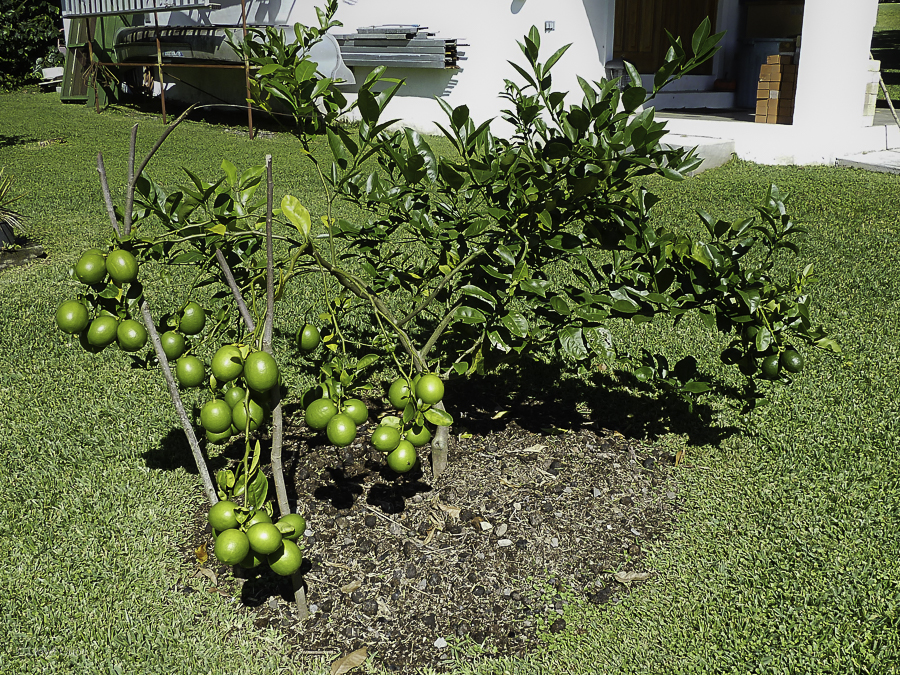
As the trees developed they produced lemons year round filling the trees. People were amazed at how productive they were.
Over the last year and especially during this dry season the trees have produced lots of lemons but they have been smaller and the trees lost a lot of leaves. This of course is due to a lack of precipitation. Here is how one of the two trees looked a week ago.
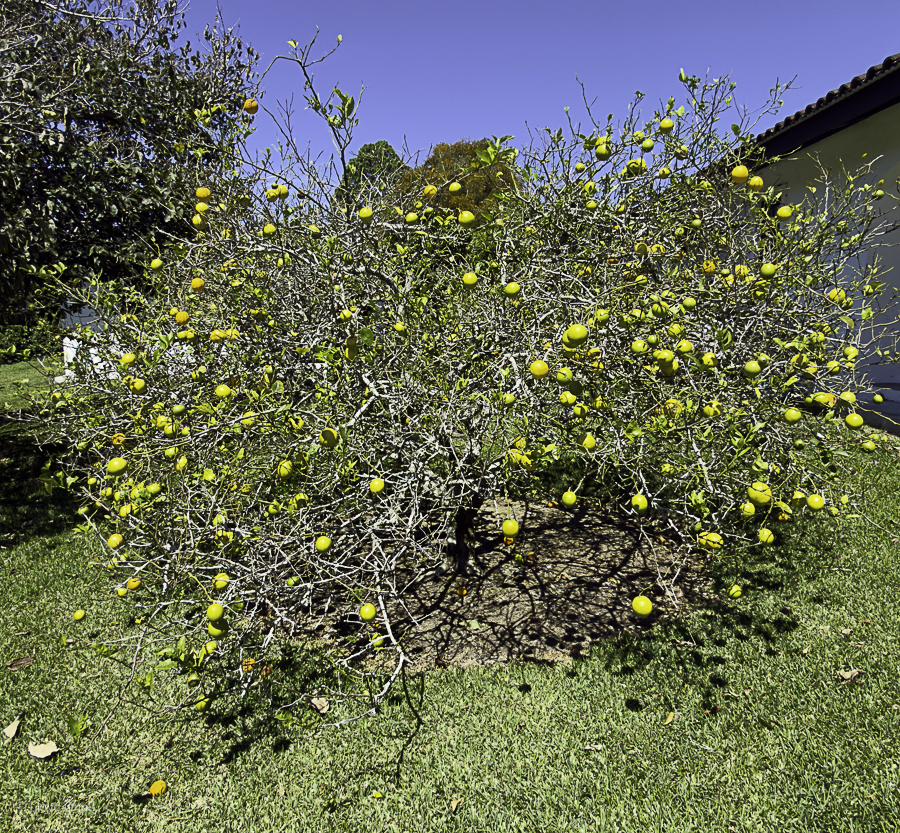
Based upon some study we have now picked all the fruit and pruned the dry limbs. We are starting to water the trees and hope to revive them. We have our finigers cross that the trees will survive and continue to provide those beautiful Meyers Lemons.
If predictions hold, we will probably have drier weather but only time will tell. Life is like that. You never know exactly what is coming next!. We will do what we can and hope for more rain. Can you believe, some areas of Panama are actually receiving too much rain?
Regardless, we move on keeping our umbrellas available if or whenever we may need them.
Lloyd Cripe